

4. Thermal convection with melting
Because of specific formulas for density and constant thermal properties of ice used in the study, the modules with rheology and material properties need to be modified in addition to the parameter file.
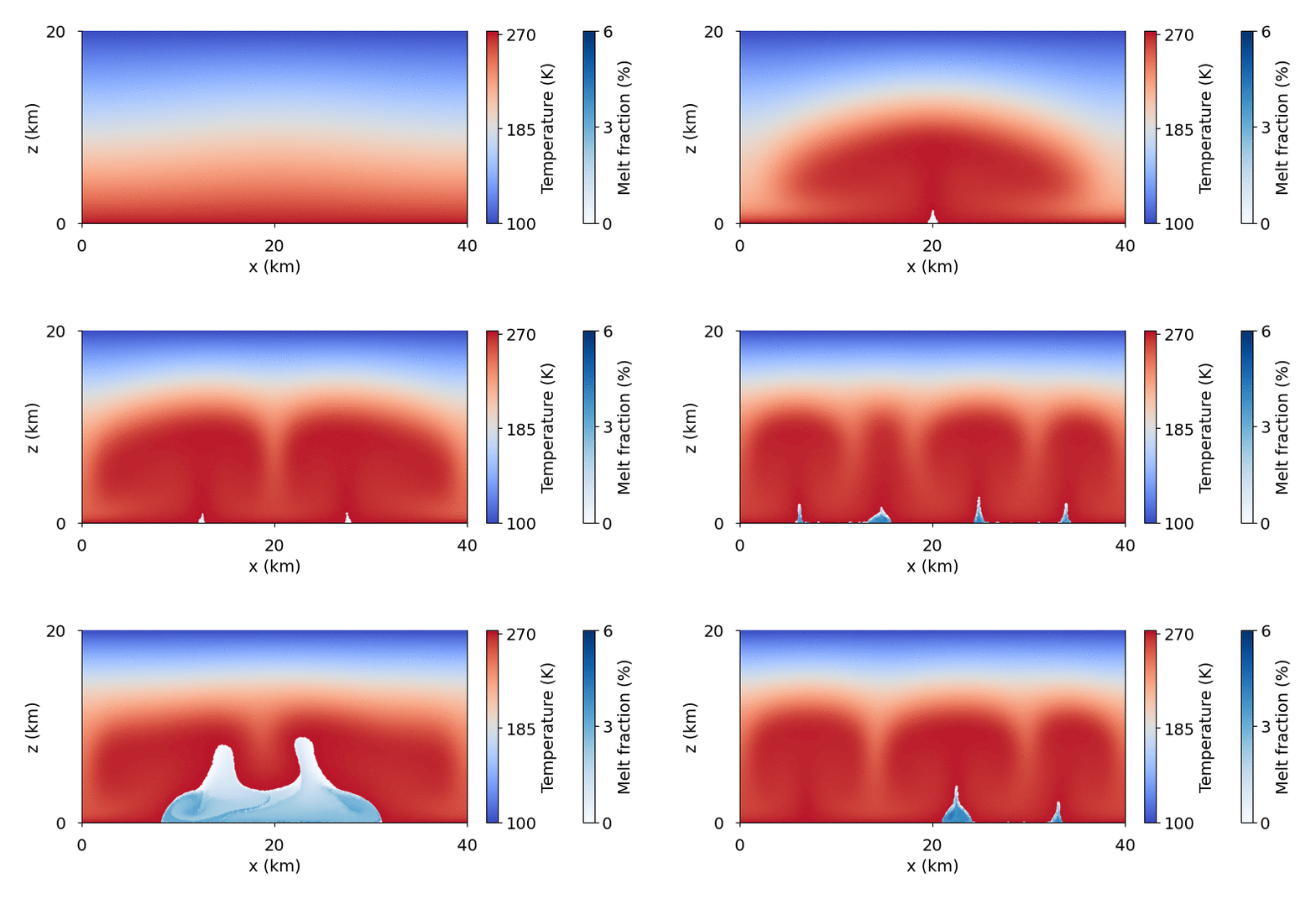
Tidally heated thermal convection in an ice shell following the setup by Tobie et al. (2003).
Parameter file line by line
The parameter file contains all parameters that can be set. Not all of them are needed for every setting, therefore here only the active ones are highlighted.
Output files settings
We start with the directory name
# --- Name of the directory with results ---
name = "convection"
The directory protection will be turned off, meaning that when lauched repeatedly, the results will be overwritten each time
# Protection from overwriting the directory above
protect_directory = False
We choose the time units millions of years and output every 25 kyr.
# --- In what units the time will be? ---
# 1.0 - seconds or nondimensional, or yr, kyr or Myr
time_units = Myr

# --- String representation of time_units ---
time_units_string = "Myr"

# --- Output method for Paraview, HDF5 and tracers ---
output_frequency = ["time", 25*kyr]
Tracers will be used for partial melt, we need to save them in order to visualize them later.
# --- Save tracers into files? ---
save_tracers = True

# --- What properties to save? Must be one of the following (order does not matter):
Tracers_Output = ["melt_fraction"]

# --- Headers for the columns in the text file for tracers
Tracers_header = ["Melt fraction (-)"]
To visualize the results in Paraview, we will save temperature, melt fraction, and viscosity. For initial condition, we will save only temperature.
# --- What functions to write into Paraview and HDF5 file ---
Paraview_Output = ["temperature", "melt_fraction", "viscosity"]

Paraview_Output_Ini = ["temperature"]
To the statistics text file, time (in the units specified above, i.e., Myr) and the duration of the time step will be saved. We also choose corresponding headers.
# --- What values to print in a text file every time step? ---
stat_output = [ "time", "timestep"]

# --- Headers for the columns in the text file
stat_header = ["Time (h)", "dt (s)"]
Reloading options
As we define our initial condition and not reload, the following options need to be set.
The number at reload_HDF5_step and reload_tracers_step does not matter, but needs
to be defined.
# --- Name of the directory from which the data will be reloaded ---
reload_name                 = ""

# --- Whether or not to load HDF5 data from data_reload_name/HDF5/data.h5 ---
reload_HDF5                 = False

# ---  Time stamp of the HDF5 file which will be loaded ---
reload_HDF5_step                    = 0

# --- What functions to read from HDF5 file when reloading ---
reload_HDF5_functions = []

reload_tracers      = False

reload_tracers_step         = 0 # Second column in data_timestamp.dat

# --- Whether to reset time when reloading ---
restart_time        = False
Simulation duration
The simulation will be stopped at 20 Myr.
# --- Criterion for ending the simulation, e.g. ["time", 1*Myr] or ["step", 1000] ---
termination_condition = ["time", 20*Myr]
Tracers options
Although tracers will be used, the options below are not relevant, because melt is the only mechanism using them, therefore the tracers will be added on the go.
sm_thickness = 500.0        # m
om_thickness = 500.0        # m

integration_method = "RK4" # Euler, RK2, RK4

tracers_per_cell = 20

weight_tracers_by_ratio = False
Mesh geometry
The computational domain will be 20 km thick and 40 km long. The mesh will be created during the inicialization, using crossed geometry of the elements. The basic elements will have the longest side of 1 km.
# --- Mesh height ---
height = 20e3 # m

# --- Mesh length ---
length = 40e3 # m

# --- Whether to read an external mesh ---
loading_mesh = False

# --- Mesh to be loaded ---
mesh_name   = ""

# --- Basic mesh resolution if not loading mesh ---
z_div = 40

# --- Number of nodes in horizontal direction ---
x_div = int(z_div*(length/height)) # (keeps aspect ratio 1)

# --- Method of dividing basic squares into mesh triangle elements. ---
triangle_types = "crossed" # crossed, left, right, left/right, right/left

# --- Rectangular mesh refinement ---
refinement = []
Material composition
The ice will consist of pure ice, therefore the list materials will remain empty.
Other options can be left as they are.
materials = []

empty_cells_allowed = False

empty_cells_composition = 0

empty_cells_region = []
Rheology
We will modify the formula for temperature-dependent viscosity, therefore we will specify the viscosity type here.
viscosity_type == "temp-dep"
Rheology file modification
Here we adopt the viscosity for the mixture of ice and melt from Tobie et al. (2003):
if (viscosity_type == "temp-dep"):
    T_bot = BC_heat_transfer[1][1]
    eta_v = eta_0*exp(-14.0*(Temp - T_bot)/170.0)*exp(-45.0*xm)
Material properties file modification
Here we adopt the density of the mixture of ice and melt from Tobie et al. (2003):
def rho(Temp, composition, xm):
        # .
        # .
        # .
        return rho_s*(1.0 - 1.6e-4*(Temp-T_ref)) + xm*rho_s*(1.0-rho_s/rho_m)
and constant thermal properties:
def k(Temp, composition):
        #return 2.3 567.0/Temp
        return 2.3

def cp(Temp, composition):
        #return 185.0 + 7.037*Temp
        return 2100.0