

2. Thermal convection with phase transition
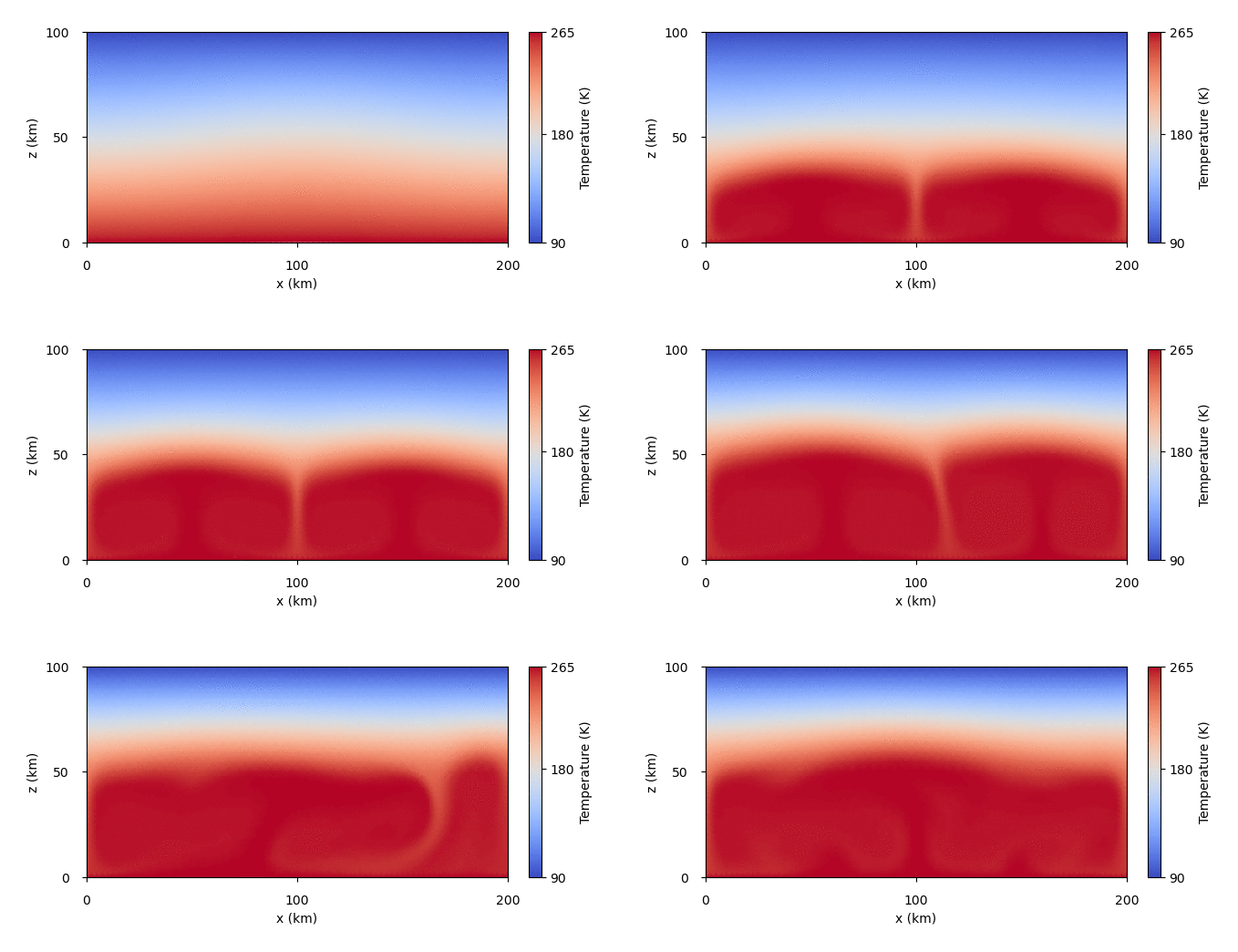
Thermal convection in an ice shell with a phase transition at the bottom boundary. Note the difference in temperature structure compared to the case with closed boundary .
Parameter file modification
Compared to the thermal convection in the previous section, we need the bottom boundary to deform, therefre we prescribe the free surface boundary condition
# Boundary conditions for velocity (free_slip, no_slip, free surface, velocity, velocity_x, velocity_y)
BC_Stokes_problem = [["free_slip"],                # top boundary       (1)
                    ["free_surface"],    # bottom boundary    (2)
                    ["free_slip"],       # left boundary      (3)
                    ["free_slip"]]       # right boundary     (4)
In order to shape the boundary by the phase transition (melting and crystallization),
we turn the phase transition on. The DAL_factor determines the “strength” of the
Deguen-Alboussière-Labrosse effect. The value 10 mW/m -3 should result in significant
ocean-shell exchange.
# --- Phase transition at the bottom boundary ----
phase_transition = True

# --- Strength of the phase transition at the ice-water boundary ---
DAL_factor  = 1e-2 # W/m3
Finally, instead of temperature-dependent viscosity we prescribe the temperature- and stress-dependent rheology following Goldsby and Kohlstedt (2001). We choose grain size 1 mm.
# --- VISCOSITY ---
viscosity_type = "GK_2001"
.
.
.
# --- Grain size ---
d_grain = 1.0e-3
Visualization of streamlines
Function compute_streamlines() allows to visualize streamlines
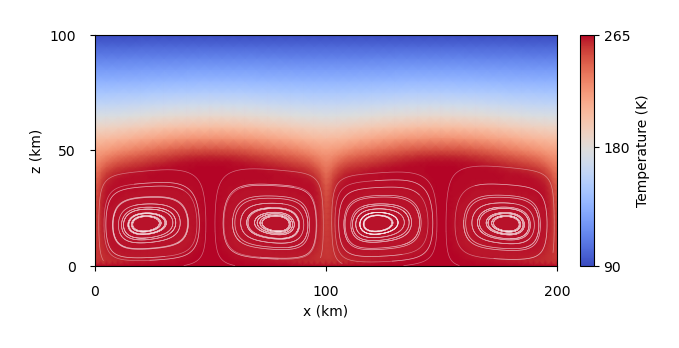
Thermal convection with a phase transition. Open streamlines at the ice-water interface demonstrate direct material exchange between the subsurface ocean and the ice shell.
Download
Here you can download the complete parameter file and the plotting scriptfor the animation.